

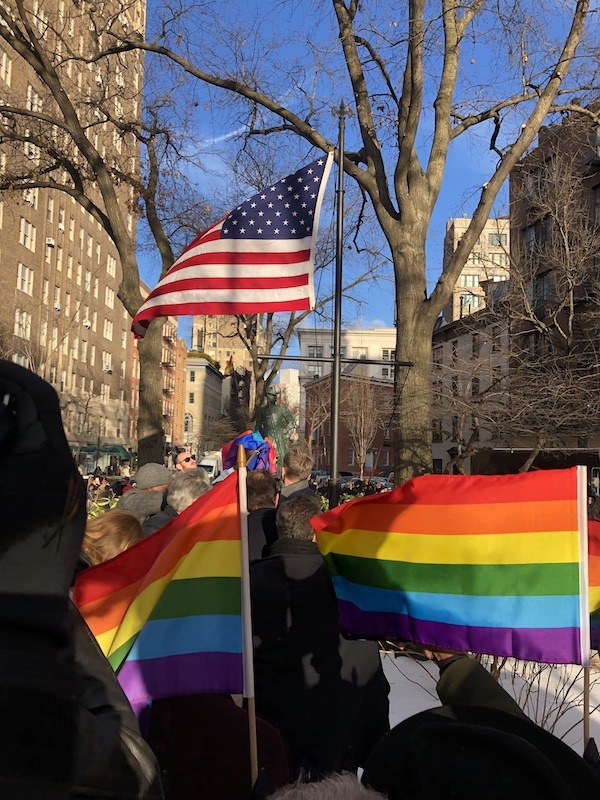
BY CHARLI BATTERSBY | On Monday, February 9, as substantially reported by NYC’s Gay City News, the U.S. National Park Service removed a rainbow flag (aka Pride flag) from the Stonewall National Monument. Located inside Christopher Park (itself bounded by Christopher, Grove, and W. 4th Sts), the Monument is situated across from the Stonewall Inn–where the rebellious uprising that followed a June 28, 1969 NYPD raid of the oft-harassed gay bar begat a tonal shift in LGBTQ+ visibility, whose reverberations were felt in the courts of law and public opinion.
The new policy was put forth in a January 21, 2026 memorandum from the National Park Service “on policies and procedures for the display and flying of non-agency flags and pennants” within the National Park System.
While allowing for limited exceptions–including current military branch flags and those “providing historical context, such as earlier version of the US Flag at a historic fort”–the memorandum also cites 2023-issued guidance from the General Services Administration that calibrates as cover for the type of action taken at the Stonewall National Monument. “Flagpoles,” the guidance notes, “are not intended to serve as a forum for free expression by the public. Rather, approved non-agency flags and pennants may be flown as an expression of the Federal Government’s official sentiments.”
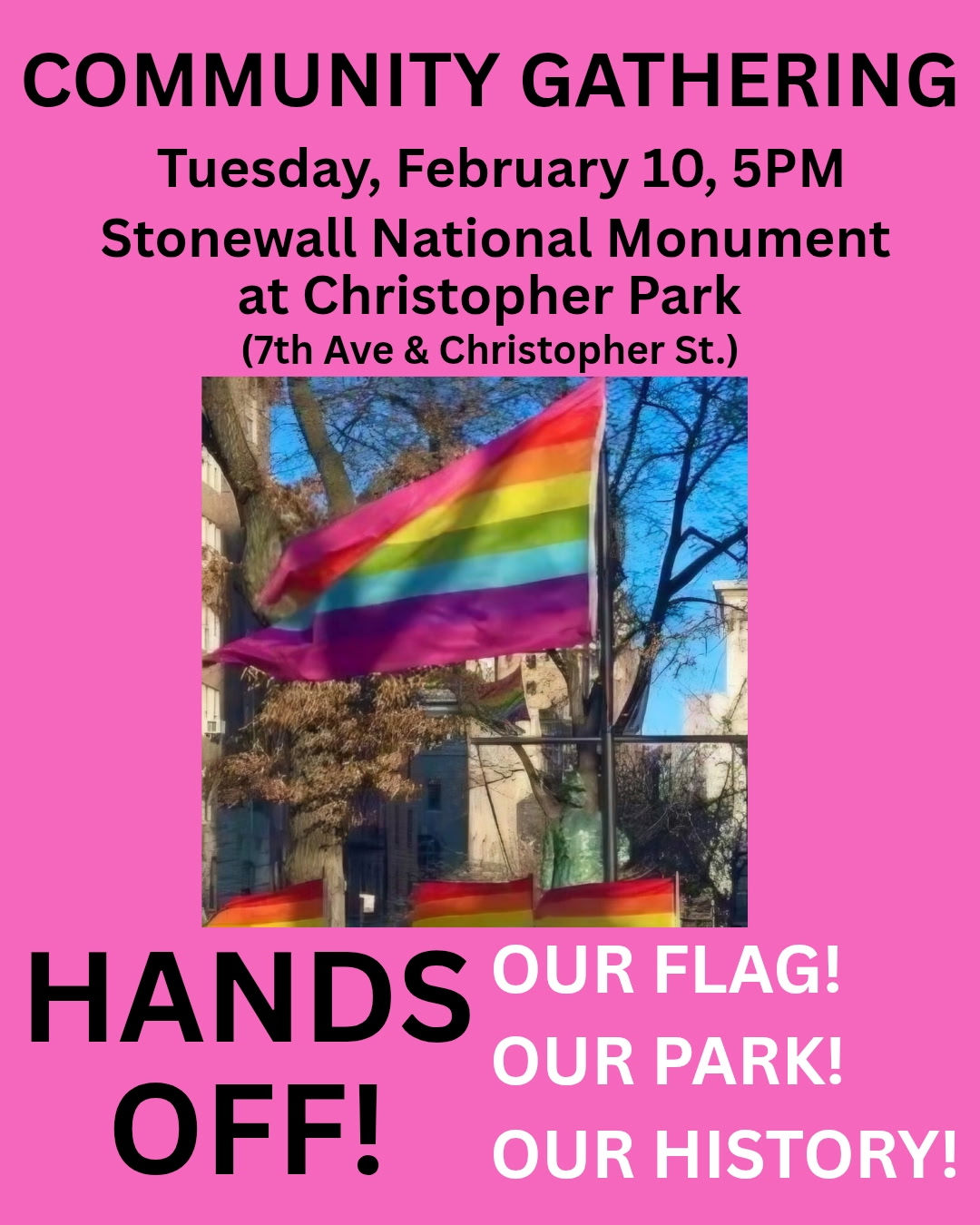
By 5pm the next day (Tuesday, February 10), a short-notice Community Gathering at Christopher Park set the tone for other expressions of outrage and resolve in the coming days, taking place alongside and inside the gated environs of the National Monument (which, in high contrast to the majestic image its name conjures, is little more than a traffic island).
On Wednesday, the National Parks Service raised the American flag; and by Thursday, news of two activations spread by the same flurry of email and social media alerts that heralded Tuesday’s Community Gathering garnered robust attendance for 9am’s “Hands Off Our History” rally
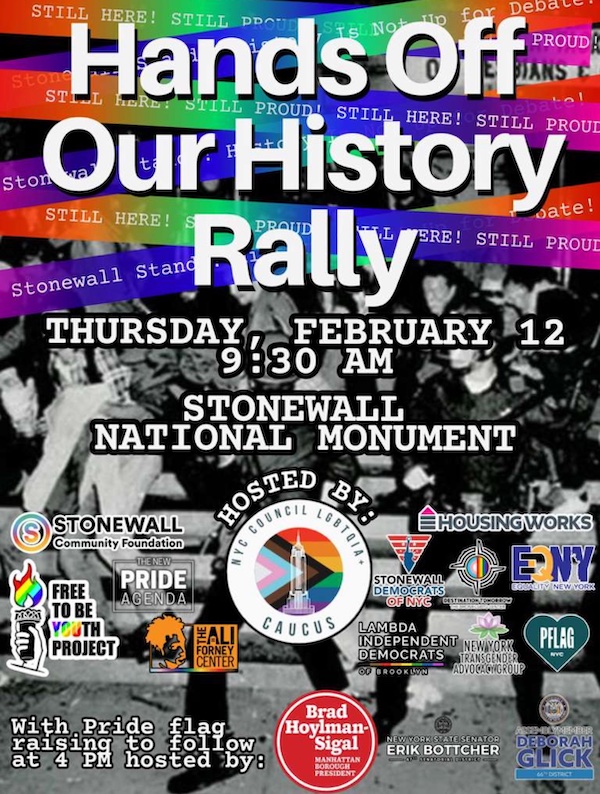
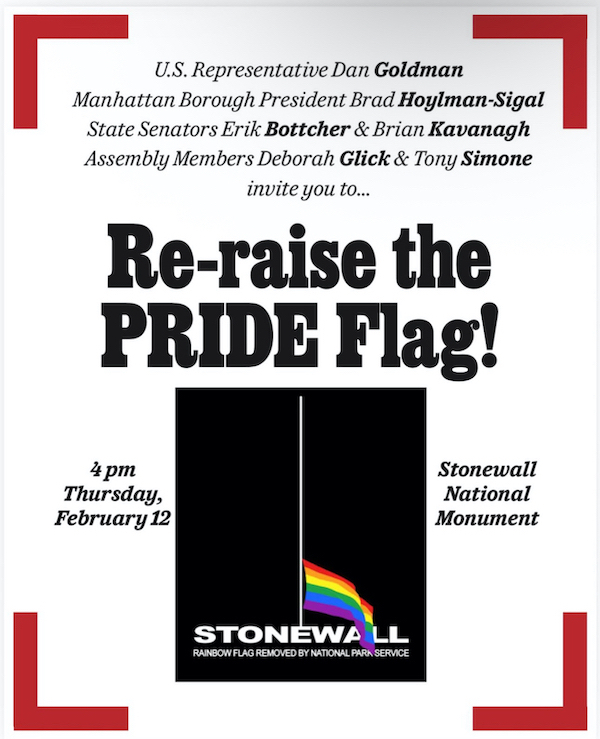
and 4pm’s “Re-raise the PRIDE Flag” gathering–at which, its organizing electeds assured, a federally unauthorized, locally sanctioned ceremony would once again see a Pride flag flying within the Stonewall National Monument’s environs.
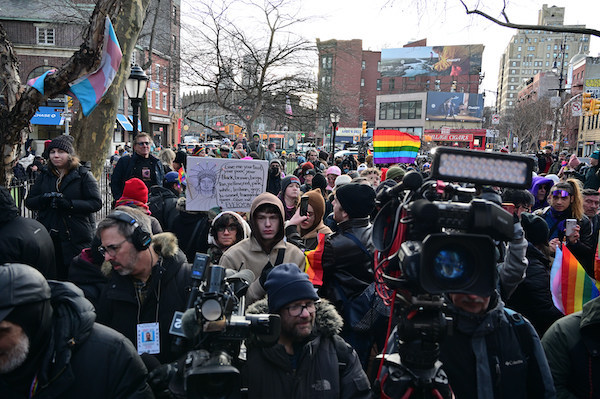
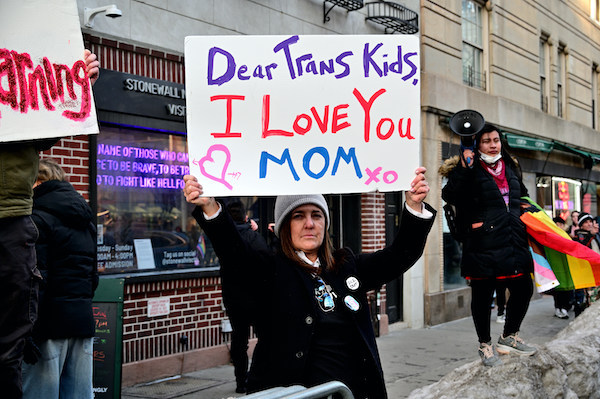
This correspondent attended the 4pm event, at which hundreds of freezing people crowded into the area around the Monument. The Stonewall Visitors Center had closed for the day, sending tourists out to join the swarm of photographers, influencers, and politicians. People were standing on waist-high snow drifts in order to get a good look.
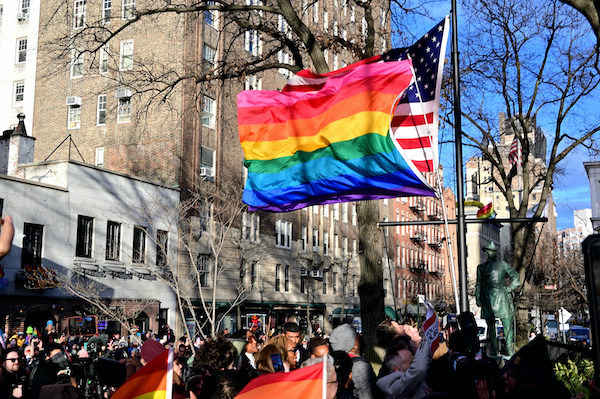
A group of electeds solemnly carried the eight-striped Pride flag into the park. It was already mounted on a separate pole. Obviously, people were wary about the optics of taking down the American flag. Ineffective attempts were made to tie this smaller pole to the larger one.
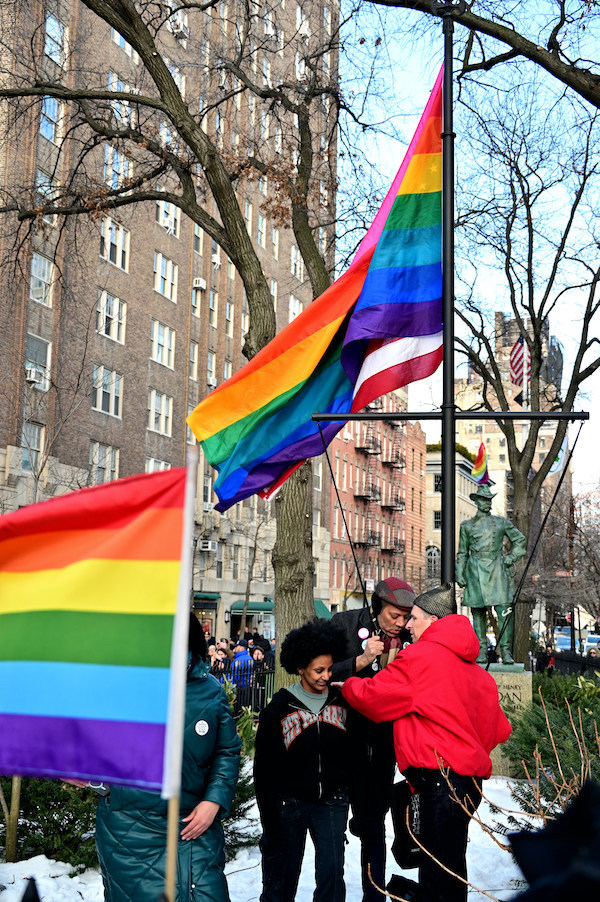
The Pride flag was lower than the Stars & Stripes. Some people in the crowd demanded that it be put on “the real pole” and that it be hoisted all the way up. Eventually, the American flag was taken down altogether. Some demanded it be put back in place, while others seemed to be cheering at the sight of a defeated enemy.
The elected officials began to disperse, while several civilians attempted to get the two flags tied together. Rigging the ropes on a flagpole is harder than it looks. Someone in the crowd made a crack about there being hundreds of gay guys, and not a single ex-Boy Scout. It took a good 45 minutes.
Meanwhile, our reporter had the chance to speak to some of State and City officials as they waited for the flags to be re-mounted.
Manhattan Borough President (MBP) Brad Hoylman-Sigal spoke to LGBTQ Community News about concerns that the federal government would take down the newly installed Pride flag. “I’m sure they’ll try. I’m sure they will. We’ll just raise it again,” said the MBP, adding, “That is the story of civil rights: You have setbacks, you keep marching forward. But this flag is more than just a piece of cloth flapping in the wind. It really represents decades of history, decades of struggle here at Stonewall, and really across the city and the entire country. I’d argue even the entire world.”
Our reporter asked what one can expect of municipal government within the confines of a National Monument. “It’s a very good point,” the MBP replied. “You know, we ceded the land to the federal government, and that was intentional because we thought that the feds were the best caretaker. But we all know now that you can’t trust [this current] Washington, and that’s a sad ending to what was an attempt by the Obama administration to make certain that pride and Stonewall were preserved. But with Trump in the White House, all bets are off.”
We also spoke to Erik Botcher, who recently won a Special Election held to fill the State Senate seat vacated when November 2025’s General Election saw Hoylman-Sigal win the race for MBP. “We’re refusing to allow our community’s symbols to be removed from our Monument,” noted Bottcher. “The Trump Administration, they wish we didn’t exist. They want us to be afraid and intimidated. We’re not going to allow that to happen….We’re going to stand for our Monument, and we are not going to be afraid… Today, we’re putting up the flag. We’re not going to stop, and we’re going to win in the end–because history is on our side. The truth is on our side.”
Kelley Robinson, President of the Human Rights Campaign, noted Thursday’s 4pm action was “not just about a flag. They’re trying to erase our history, continuing an assault on our rights all across this country–so to see hundreds of people show up on a moment’s notice to say, ‘Not on my watch,’ it’s powerful.” Robinson also had a message to elected leaders and aspirants with their eyes on midterm elections: “You need to be paying attention, because the will of the people is going to make itself heard come November, for sure… If we’re going to take back a majority in the United States House, that path has to come through New York. So I think it matters in that way. But it also matters, you know, on a personal level. I’m a mom, I got two young kids. If they see the President of the United States–if this community sees the President of the United States==pulling down our flag, it also pulls down the respect and dignity that my kids and my family get in every area of our lives. And we’re better than that. New York is better than that. Our country is better than that. So seeing folks come out, I think it’s a testament to the fact that what’s happening here [federally] is not representing the best of who we can be.”
Asked about pushback from the federal government, Robinson replied, “Yes I do. And guess what? I expect us to show up again and again and again to make it clear that we’re not going to stand for it. This is sacred ground, right? I mean, 1969 the start, the Stonewall Rebellion, really spurred so much of our movement. Trans women of color led so much of our movement. We got to make sure that we stand up in a way that gives honor to the legacy of their lives, and to claim what we’ve already fought and bled for. We fought for this land. Tbis is ours, not anybody else’s.”
Regarding the significance of the eight-stripe Pride flag, Robinson observed, “There’s so many flags with so many colors but this one, particularly, the reason that I love it is that it also has a pink stripe which represents sex positivity, right? So it speaks to every element of our lives, representing the lesbian, gay, bi, trans, and queer people. But also our ability to be proud of who we are, and not ashamed of our identity.”
Later, we spoke with NY State Assemblymember Alex Bores, who noted of Trump’s orchestration of Monday’s Pride flag removal, “His action is not a neutral act. It is an active choice. He didn’t have to do it, but it follows on him erasing any reference to trans people from government websites. Now they’re pulling down a flag. It’s a coordinated attempt to erase LGBT history. But LGBT is American history, and so we’re here to restore it.”
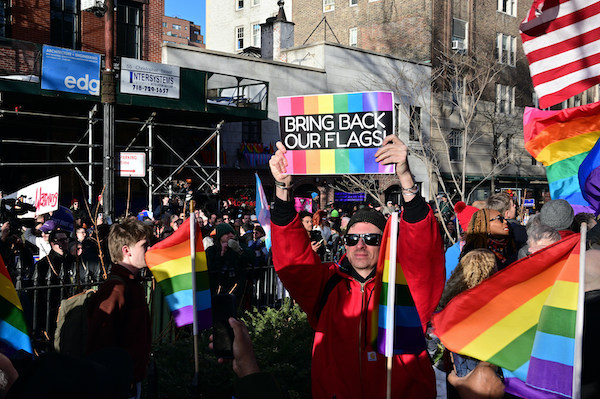
NYC Public Advocate Jumaane D. Williams told us, “I’m not a member of the LGBTQI+ Community, which is exactly why I need to be here. And we need a lot more people out here who are not members of communities who are being attacked. It’s important.”
Williams cited the recent changes to another national monument, The Medgar House, where brochures were removed from the sight because they contain references to Medgar Evers’ killer being a racist. That happened only days before the flag was taken down at the Stonewall. Asked what the local government can do about a national monument, he said Thursday’s action “is a great step. Just coming here with all the local officials, and making sure we put that flag back up. Yes it’s symbolism, but it also shows New York City communities that are afraid and worried that their local government is going to do everything we can to make sure that everyone is protected… It’s a rough time in this country. What gives me hope is the fact that there’s been a better part of this country that has always fought back, and that has always pushed forward.”
Then, the staunch and studied ally closed by paraphrasing Drag Race host and co-creator RuPaul, noting, “It’s okay to look at the darkness. Just don’t stare at it.”
Eventually, the two flags were tied together, and raised up the Stonewall National Monument’s flagpole. Side by side. Equal height.
—END—
—Additional reporting by Scott Stiffler
 ABOUT REPORTER CHARLI BATTERSBY | Charles (Charli) Battersby is a playwright, screenwriter, actor, model, game designer, and journalist. Battersby is known as a playwright for, among others, The Astonishing Adventures of All-American Girl & The Scarlet Skunk. Battersby is the screenwriter/co-creator of the animated web series The Storyteller: Fallout. She has written about video games, theater, and LGBT topics for media including Geek.com, Complex, and Joystiq. Battersby has moderated a series of panel discussions on Transgender themes in comic books.
 ABOUT PHOTOGRAPHER DONNA ACETO | A NYC-based photographer specializing in events and political activism, Aceto has been Lead Photographer for AIDS Walk New York for 25+ years and was the primary photographer for Gay Men’s Health Crisis for 15+ years. Her clients include the NY Civil Liberties Union and the Edith S. Windsor Trust. Click here to access archival photos available for licensing for publication as well as fine-art prints for framing.