


BY ANDREA ALTON | Mara Lieberman’s inventive and timely play Dirty Books explores the First Amendment, censorship, and the world of underground erotica—and it’s absolutely riveting.
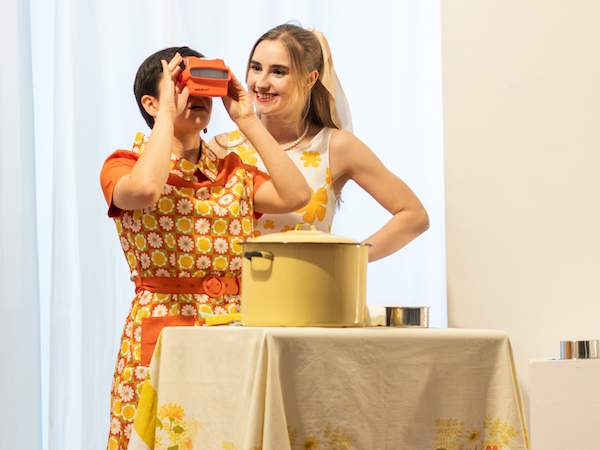
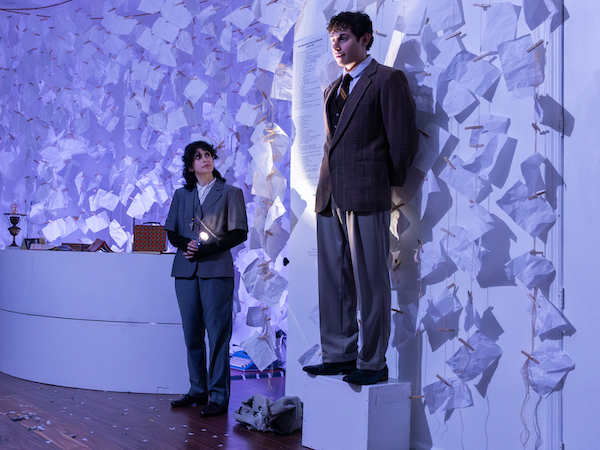
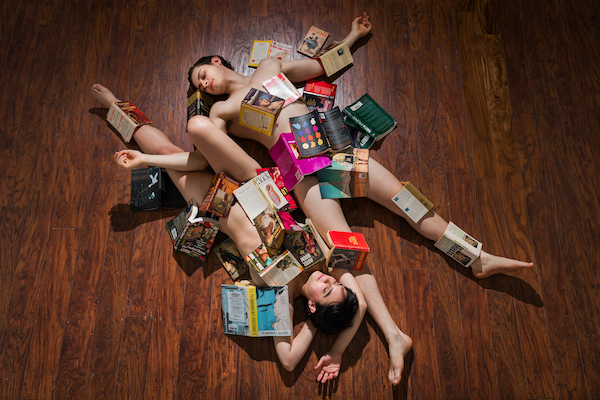
The immersive experience begins as you walk into the space, which is part art installation. Audience members are given a “Museum Pass” and encouraged to explore the setting, which include piles of banned books pulled from a fire, the First Amendment printed on a large canvas, and Viewmasters with erotic lesbian scenes from the 1930s.
The play opens with cast member Caroline DeFazio delivering a brief history lesson on United States Postal Inspector Anthony Comstock, who successfully lobbied Congress to enact the Comstock Act of 1873, which made it illegal to mail “obscene” material. Dirty Books focuses on the soft-porn publishing industry of the 1960s– a time when writers were targeted for violating the law.
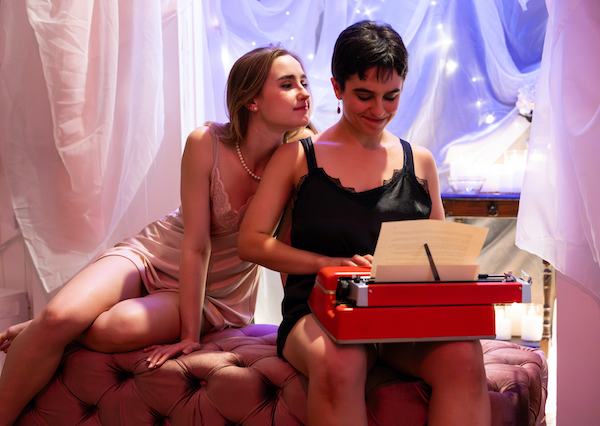
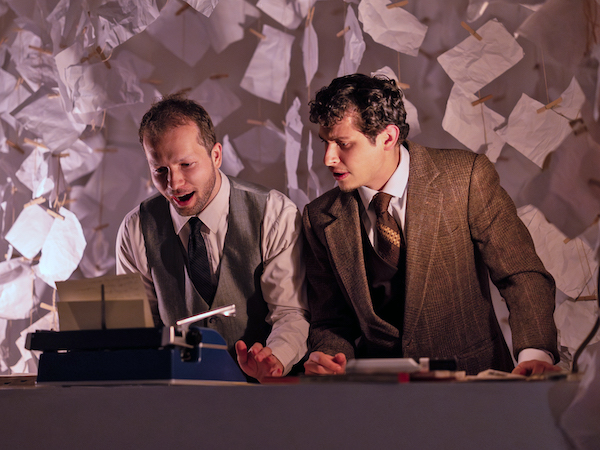
Grayson Willenbacher and Sammy Rivas gamely tackle their roles as two such writers busy churning out soft porn novels. When they have a couple’s dinner, their wives meet for the first time and forge a friendship. After dinner, the men retire to the office to work on the book they are co-authoring. When the women retire to the kitchen to tend to their domestic duty (doing the dishes), sparks fly–igniting a whole new path for the wives. The heart of the show lies in the blossoming relationship between the two women, played beautifully by Alexis Pratt and Melina Rabin. They ultimately must decide whether to take the unsafe road less traveled or remain with their husbands.
Alexis Pratt and Melina Rabin shine in their roles as two women finding love. Watching the dance between them as they discover themselves and each other is spellbinding. DeFazio keeps the show moving as a warden of words and skillfully weaves together the story, audience suggestions, and vignettes which jump from place to place.
Yung-Hung Sung’s set design transforms the intimate space into multiple playing areas across which the layered, compelling, and ultimately liberating story unfolds. Lieberman created Dirty Books in collaboration with the Dirty Books Ensemble. The end result is a unique and innovative evening of theatre. Whether you are looking to learn about America’s past with censorship, or for a steamy love story between two women, Dirty Books delivers.
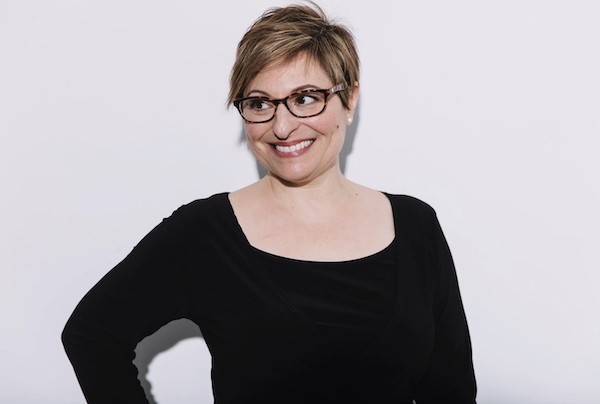
Andrea Alton, for LGBTQCommunityNews.nyc (Andrea): What is the first “dirty book” you remember reading, fully aware that it was taboo?
Mara Lieberman: Creator/Director, Dirty Books (Mara): My Secret Garden: Women’s Sexual Fantasies by Nancy Friday. I remember reading it with the delicious feeling that I was peering into something forbidden—and even more thrilling was the shock of recognition, seeing myself reflected in some of those pages. Even then, I understood the radical scope and fluidity of women’s desire, and how powerful it is to see female fantasy explored so openly.
Andrea: The press material notes the play is based on true stories of erotic fiction writers of the era. Was there a specific dirty book or writer of that genre that inspired you to create this production? If so, how do we see those influences expressed in the characters, language, tone, etc.?

Mara: A few years ago, I met a man who had written erotic stories for a living back in the 1960s. The way he described these men sitting around a table, each taking a few minutes at the typewriter, fascinated me—not just as a collaborative model, but as another example of how women’s sexual subjectivity (especially queer women’s) was being written out of stories supposedly about their desire.
I initially imagined a play about a woman who discovers her husband writes soft-core porn and decides to out-write him. In the process, she falls madly in love with his business partner’s wife—all while the audience participates in writing the story within the constraints of the era’s anti-obscenity laws.
The piece has evolved a great deal since that spark, but the DNA is still there. It still carries the sensibility of mid-century erotica—the way men related to their wives, the blind spots, and the unexpected awakenings that lead women to recognize their own worth and right to happiness.
Andrea: The program notes point out that this production was created with members of the Dirty Books Ensemble. How did you find the actors?
Mara: Regular auditions—but with very specific eyes. I look for actors with devising experience, physical-theater training, and a genuine excitement about audience interaction. In a devised process, it’s easy to get attached to your own ideas, but this work requires the opposite: you have to throw everything at the wall and trust the person leading to create the best final result. That takes humility, resilience, and a real commitment to artistic excellence. The actors in Dirty Books wear many hats, navigate real-time chaos, and still bring the show back with agility and generosity. That rare combination of bravery, flexibility, and discipline is what defines the Dirty Books Ensemble.
Andrea: What kind of environment did you establish in rehearsals, so the actors would feel safe to explore?
Mara: We worked with an intimacy director, Lauren DeLeon, who was extraordinary. She gave us a shared vocabulary and concrete tools so intimacy could be approached as choreography rather than something vague or improvisational. We never say, “Okay, be sexual now.” Instead, we break it down physically and emotionally: here the breath increases, here this part of the body activates.
We also do daily boundary and consent exercises—what areas are okay to touch, what’s off-limits, how to check in if something shifts. We never dive into intimate moments without talking through what will happen and getting explicit consent. That structure gives the actors a real sense of safety, so they can take risks, explore, and stay present with one another.
Andrea: The play is framed around America’s censorship and anti-obscenity laws of the 1960s. What can that teach us, about our current era, when facts are often labeled as “fake”?
Mara: I think it teaches us that progress is not linear. America has always been torn between its puritanical roots and an evolving idea of personal freedom. Every few decades, we hear the same panic—the 1880s, the 1920s, the 1960s—it’s the same record playing on repeat. The language shifts, but the impulse is the same: to “protect” society by restricting what people can read, say, or know.
What’s happening now, with facts being labeled “fake” and books being banned again, is part of that same swing of the pendulum. My hope is that the play lets audiences feel the timeliness without us having to underline it.
Andrea: Were there any works of nonfiction and/or any archival sources that were part of your writing process?
Mara: Yes. I do a tremendous amount of academic and archival research when I’m writing. I read everything from online dissertations to legal histories to books and articles about the craft of writing erotica. We ordered stacks of vintage paperbacks from the period, along with Susie Bright’s How to Write a Dirty Story and a remarkable first-person account from someone who actually wrote these books for a living.
I also dug into the history of anti-obscenity law—especially Charles Rembar’s The End of Obscenity, which really lays out the legal framework that shaped our “obscenity standards” today. And I spent a lot of time with catalogues of mid-century cover art and story synopses, which tell their own story about what was marketed, censored, or hidden.
But perhaps the most influential book was Amy Sohn’s The Man Who Hated Women, which gave me a powerful and unsettling window into the crusades against women’s autonomy and sexual expression. That book stayed with me more than almost anything else.
Andrea: If you were to hand out a Recommended Reading List as audiences left the theater, what would be on it?
Mara: I love this question. My recommended reading list would be a mix of history, personal awakening, and pure delight:
—The Man Who Hated Women by Amy Sohn
—Lust on Trial by Amy Werbel
—How to Write a Dirty Story by Susie Bright
—Supreme Court obscenity case transcripts (they’re wild and illuminating)
—A deep dive into articles on the craft, history, and ethics of erotica—how writers build desire on the page, how censorship shaped the genre, and how erotica has served as a space for women and queer people to write themselves into existence
—Histories of Anthony Comstock and the censorship movements that shaped American moral panic
—Eat Pray Love by Elizabeth Gilbert
—Bittersweet by Susan Cain
—And, for a little joy and irreverence: My Dad Wrote a Porno by Jamie Morton, James Cooper, and Alice Levine
It’s a mix of the serious, the historical, and the deeply human—which is exactly what inspired Dirty Books.
The Bated Breath Theatre Company world premiere production of “Dirty Books” is performed on various dates through January 18 at Bated Breath Theater (39 West 14th Street, #301). General Admission tickets are $69. VIP tickets (priority seating, complimentary refreshment, custom piece of merchandise exclusive to your performance) are $99. To order, click here. To visit the play’s website, click here.
—END—
LGBTQCommunityNews.nyc is an independent, free source of queer-centric news, arts, info, and opinion content. Our website, podcast, and quarterly newspaper are funded by advertising revenue and reader donations. To support this project, click here for the GoFundMe campaign. Questions? Comments? Click here to contact us. To join the subscriber list of our free ENewsletter, click here.