

BY CHARLI BATTERSBY | I didn’t feel particularly rebellious when I walked into my first roller derby training session in mid-May of 2026. It felt like I was going roller skating with some new friends—a perfectly normal thing to do in springtime. But I was rebelling, because there are places in New York State where I’m discouraged from playing roller derby because I’m transgender.
It wouldn’t be correct to say I’m “not allowed to play roller derby because I’m trans.” But there is a Nassau County ordinance that effectively bans me from playing or practicing roller derby at very specific locations.
Signed by Nassau County Executive Bruce Blakeman on July 15, 2024, Local Law 121-24 (aka “Fairness for Women and Girls in Sports”), prohibits transgender women and girls from competing in women’s and girls’ leagues, organizations, teams, or programs that take place at Nassau County public parks, facilities, and venues.
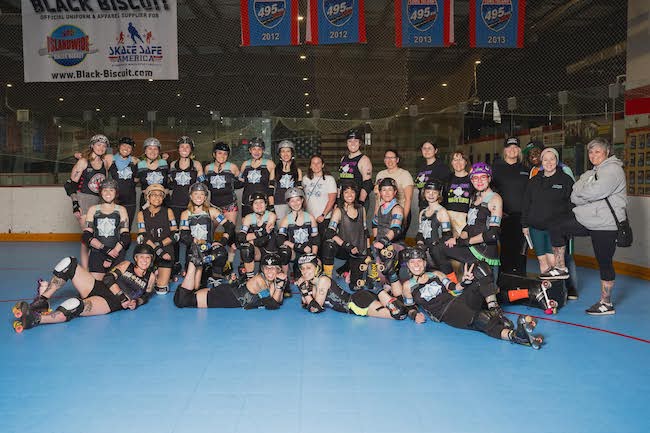
A roller derby league called the Long Island Roller Rebels initiated a legal challenge to the Nassau County policy in 2024, and the case has slowly been making its way through the legal system. It is still not resolved, forcing the Roller Rebels to practice in private facilities, because they have transwomen on their teams.
According to court filings from 2024, Nassau County says, “To be clear, the Executive Order does not impose a blanket prohibition on transgender individuals from participating in sporting events held at Nassau County facilities. In fact, the Executive Order invites transgender biological males to compete except in teams and leagues that advertise or identify as exclusively all-girls or all-women.”
At a March 1, 2024 press conference in response to a cease and desist letter from NYS Attorney General Letitia James, County Executive Blakeman noted, “When we did the executive order, it was very clear that biological males who are transgender would have other opportunities to compete, they would not be foreclosed from sports competitions in Nassau County because it would be the wrong thing to do.” (Source: New York Post, March 1, 2024).
It means that people like me could play on an all-male or co-ed team. It even specifies that all-trans teams would be welcomed at a Nassau County roller derby track. Nonetheless, one of the reasons I decided to start roller derby training was the nagging sense that I might eventually be told I’m not allowed to.
So I signed up for the “Basic Training” at New York City’s own roller derby league, Gotham Roller Derby. This eight-week course is the first step for hopeful roller derby players to develop the necessary skills to become jammers, blockers, and pivots. Each team has one jammer, who scores points starting with the second time they pass through the opposing team’s pack of four blockers–one of whom, the pivot blocker, can take over as a jammer. At the end of the time limit, the team with the most points wins. (I learned this, and more, on the “Derby 101” page of the Roller Rebels’ website.)
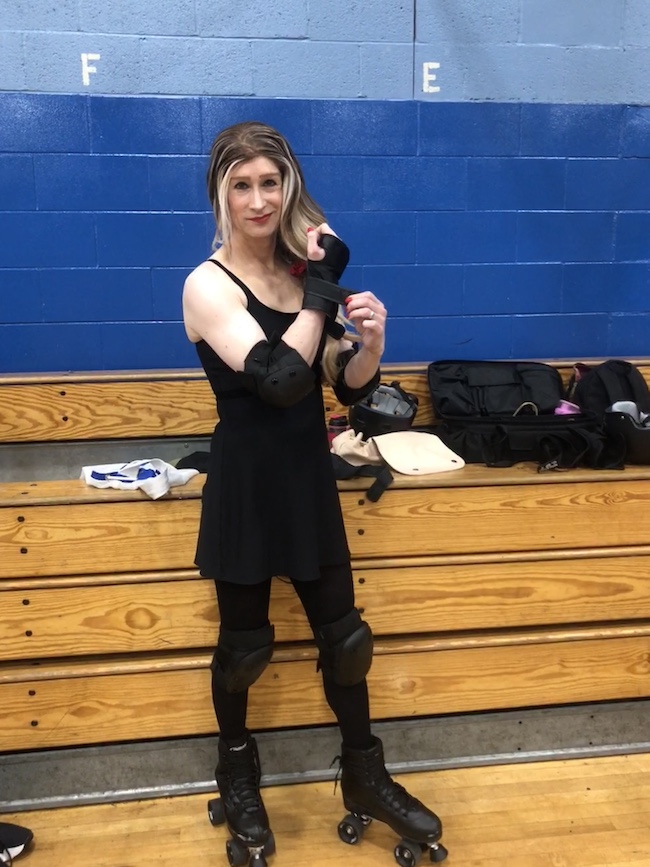
Shortly before my first training session, I spoke with a representative from the Long Island Roller Rebels. Lee O’Connor, Public Relations and Community Outreach Officer (track name, Ghastlee”) uses nonbinary pronouns. Ghastlee joined the Roller Rebels shortly after they filed their legal challenge to Nassau County. “The team made the news for this reason,” Ghastlee told me. “That was when I, as well as several other [transgender] skaters joined the team.”
Asked if people were taking up roller derby out of spite or a sense of rebellion, Ghastlee said, “I certainly did. And then I came to find a really wonderful and welcoming community that I fit right into, and I adore. It’s become a family affair as well. My wife, who is also a transgender woman, does not skate—but she joined as a volunteer… So we both got really involved, and we both love it.”
Lee continued with, “Roller derby in general has always had the spirit of rebellion and the sense of gender nonconformity or gender outlawism. There is a construct about traditional femininity—that it is weak, that it is passive, that it is quiet and nurturing and caring. Women can be all these things, but roller derby is a sport where we put on skates and we run into each other really hard, and we do a lot of very physically aggressive, very violent things.”
Roller derby, Ghastlee asserted, has the “sense of gender nonconformity baked into it, which also means that it’s a safe space not only for women who want to do this, but for gender nonconforming people,” Ghastlee explained. “There’s obviously been a lot of nonbinary people in roller derby, and there’s also been a lot of transwomen in roller derby, from the jump.”
Ghastlee also discussed cisgender female skaters who compete on men’s teams, and how the WNBA has players as big as the biggest trans woman on the Roller Rebels.
“When someone has roller skates on, that’s the great equalizer, in terms of physical force,” they told us, noting, “Women hit just as hard as men out there on the track. I have skated against cisgender women, I have skated against cisgender men, I have skated against transwomen, I have skated against nonbinary people. There’s really not that much of an appreciable difference.”
When I asked about the drastic size difference between the biggest Blockers and the smallest Jammers, Ghastlee explained, “If there’s a tall blocker coming towards you, you know what you do? You get low! They can’t get that low because they’re tall. It’s not necessarily the cheat code that some people might think it is.”
Later, I conducted an interview with Abigail, who goes by the track name “Mayday.” She is a Jammer on the team, as well as a Roller Rebels coach and captain, and the league Safety Coordinator.
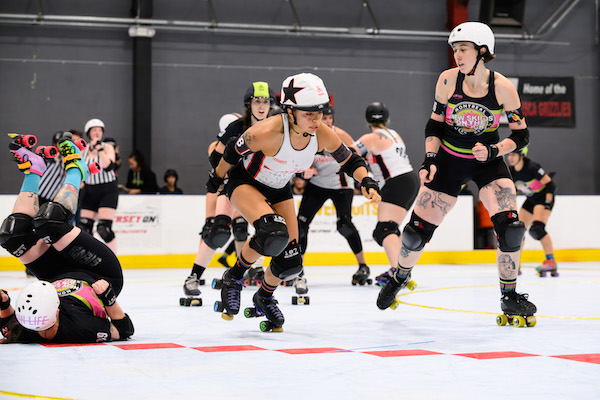
Mayday told us she “Grew up mostly playing ice hockey both on club teams and school teams. My dad started me with skating lessons when I was around four or five years old, and I’ve been on some kind of skates ever since.”
After her transition, Mayday continued to skate recreationally, but had not competed. This was “partially due to the lack of opportunities during COVID, but also because of the fear of being a visibly trans athlete while there was rising transphobia across the country, especially in sports… I began looking for any leagues I could join in that would maybe be ok with having a trans woman on their team. Unfortunately, it looked like hockey would be out of the running. Having grown up in that environment, I can confidently say that hockey culture has some problems with homophobia, transphobia, misogyny, you name it, and that would be an understatement.”
Mayday had friends who played roller and they suggested it to her. “I didn’t know anything about roller derby at that point, I hadn’t even watched Whip It yet,” she told me, referencing the 2009 roller derby movie starring a young Elliot Page. Mayday sent an email to the Roller Rebels and “got a very warm response back, but I started to get worried. I hadn’t disclosed that I was trans—and knowing next to nothing about the derby community, I wasn’t sure if they would be accepting of me once I showed up in person. So I got cold feet and didn’t respond and didn’t go. My friends were telling me that the league would almost certainly be cool, as their experiences as trans women in derby was pretty great for the most part. But I was afraid that with the growing hate towards trans women, I wouldn’t be able to find real allies on Long Island.”
Mayday, who contacted the Roller Rebels at about the same time that Nassau County instituted its ban on trans women athletes in county facilities, told me, “The ban and the following lawsuit changed everything for me. All my fears about the team not being a safe place for me vanished instantly, and I reached back out to the Rebels to join shortly after. I was definitely scared about a law like that being passed in the first place, especially in my county, but I was also inspired by what the league was doing, and wanted to join the fight. It was more than just me looking for a sport to play at this point; I knew I wanted to join this league in particular so I could fight back for my community and help however I can.”
After the first practice, recalled Mayday, “ I knew I was in the right place, especially once I saw that I was not alone in being a trans athlete here. It was honestly incredibly healing to see that despite all of the hate and the restrictions put on us, that there were other trans people playing sports and having fun and that I was now sharing a community with them. I can’t comment more on the lawsuit, but what I can say is I am happy to be vocal and visible in my support for other trans athletes and to show that we cannot be intimidated out of our existence.”
A few hours after my conversation with Ghastlee, I was off to my own first session with Gotham Roller Derby. Gotham used to be called “Gotham Girls” until a few years ago, when they changed their name to be more explicitly welcoming to trans people and people who don’t conform to the traditional gender binary. I am by no means a trailblazing first transgender roller derby trainee. I wasn’t even the only transwoman at the training sessions I attended.
And I was hardly an expert on the sport. Like most people, I discovered roller derby from old movies and TV shows. The episode of Charlie’s Angels where Farrah Fawcett goes undercover as a roller derby girl was very misleading. First of all, Farrah was skating around without a helmet; her trademark blonde “Farrah wings” flowing behind her.
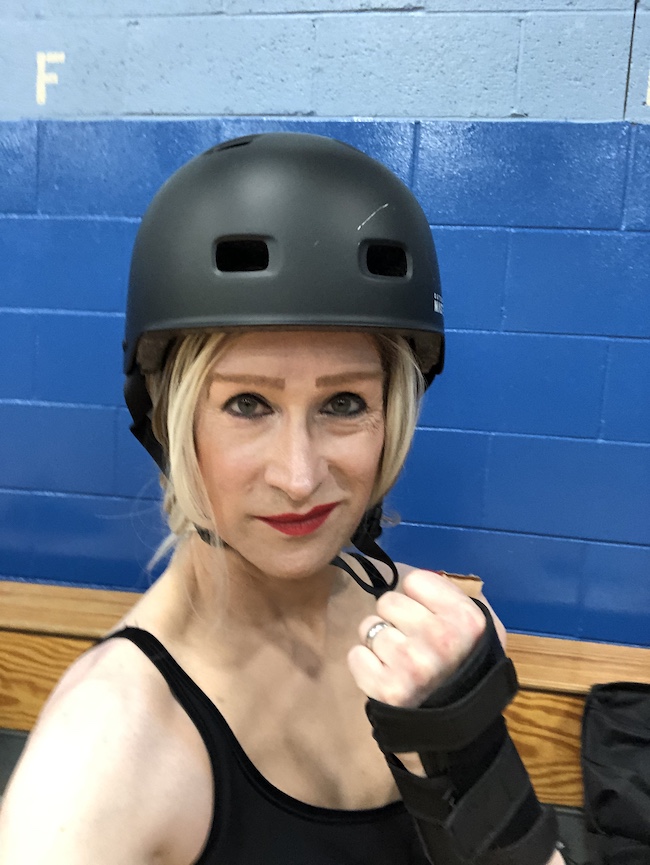
The James Caan movie Rollerball had some embellishments too; there aren’t any motorcycles in a real roller derby match, and there isn’t a cannon that fires steel balls around the track.
Modern “Flat track” roller derby is a legitimate sport, with rules and safety procedures. This was a safe event where the team wanted to recruit new skaters, not a meat grinder at gladiator school. I needed mandatory pads, helmet, and mouthguard just to take my “Baby’s First Derby” class. I even had to get a special health insurance policy just for roller derby players. Yikes!
And I don’t skate well. I was, arguably, not the worst skater at the training session. And I suspected that I was genetically incapable of skating backwards. Everyone else was able to wiggle their hips in just the right way to glide backwards. Must be my male hip bones…
To prepare for this class, I had taken roller disco classes at a rink in Bushwick. In roller disco, we practiced how to skate slowly and evenly. Pushing and stepping to the beat of the music, always moving at the same rhythm as the other skaters. We carefully skated around other people. The only contact I had was holding hands with a partner and skating safely together. Gentlemen were told to not skate too fast, so that the ladies on the dance floor wouldn’t be injured.
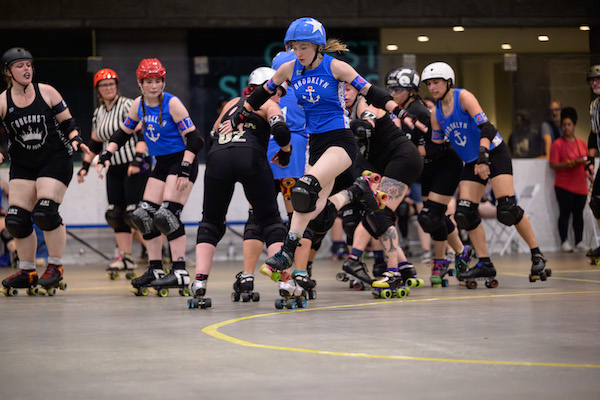
This had almost nothing in common with the skating techniques I’d need for roller derby! We skate fast in roller derby. You don’t avoid contact. Blockers are there specifically to block the other team’s jammer. They form human walls, and “packs” to keep the opposing jammer from ramming through the line.
By contrast, on the roller derby track, jammers and pivots score points by lapping (passing opponents on them on the track) the other team. We learned fast-moving techniques similar to what I had seen Olympic speed skaters use—the crossover step, and how to cut corners on the oval track so that we could build speed by moving in a tight circle.
We also learned how to fall. Always trying to go forwards and let our knee pads cushion the blow, rather than falling backwards on our tailbone. I was warned to keep my fingers curled if I do fall forwards onto my wristguards. This would prevent the other skaters from rolling over my fingers.
But no one tried to roll over my fingers. The derby skaters were all supportive of each other, and welcoming to me. No one mocked my inept skating. I met some of them a few months earlier at a league fundraiser. When not competing, they’re all nice. Although I’m sure they’ll have no mercy if I ever play against them in a competitive match.
We ended that first session with a two-minute race around the track. Derby matches are divided into “Jams,” which each last up to two minutes. These final minutes of the session were my first taste of what it’s like trying to “Lap” other skaters. The more skilled skaters zoomed past me easily. I wondered if I had any advantage because I’m trans.
Two weeks later, I attended my second training session. This time around, I had adjusted my skates according to advice I received from the coaches. My “trucks” were loosened to give me more maneuverability for backwards skating. Plumber’s tape would keep my toestop from wiggling loose. My helmet and pads were scuffed and dirty.
And it turned out that I could actually skate backwards. A little practice, and proper adjustment of my equipment was all it took. It’s not genetic. It’s not a question of my male hip bones being unable to wiggle in the proper way. I just needed more practice. My male shoulder bones did make it easier for me to do pushups and planks during the warmup at the start of practice—but once the skates were on, I didn’t feel like I had a natural edge on the track.
Roller derby is a skill-based game, as Ghastlee told me. We aren’t allowed to punch each other, or grapple. Longer arms and bigger biceps aren’t much help. Skill, balance, maneuverability, and technique are what matters.
At 5’9″ I’m objectively taller than most of the other skaters. The other transwomen were taller than me, but none of us are hulking brutes that put anyone in danger just by skating next to them. I couldn’t see any reason why my Y-chromosomes should prevent me from doing this at a Nassau County facility, or why there should be a rule against me doing this anywhere else.
Before I headed out to the first training event, I asked Ghastlee for any final thoughts. “I know right now things feel dire, especially for trans women, and for trans children.” they said. “Things have felt dire for us before, and the best thing that you can do is find your community and find people like you that you can hang out with and build your own collective.”
“You can’t control what people in government are doing most of the time, but you can control what you’re doing in your community. So go out there and build some community, and make some friends, and go see a roller derby game.”
I also asked Mayday if she had anything to leave our readers with. “Community is the most important thing that we have right now,” she told me. “Community between ourselves, our allies, with perfect strangers, and our closest neighbors. We need each other more than ever now. You don’t need to be a hero to make a difference. Sometimes just getting out there and creating and sharing space with each other is the start of something beautiful and powerful. Trans women have always been here, and we’re not going anywhere.”
—END—
ABOUT: LGBTQCommunityNews.nyc is an independent, free source of queer-centric news, arts, info, and opinion content. Our website, podcast, and quarterly newspaper are funded by advertising revenue and reader donations. To support this project, click here for the GoFundMe campaign. Questions? Comments? Click here to contact us. To join the subscriber list of our free ENewsletter, click here.